Notice. New forum software under development. It's going to miss a few functions and look a bit ugly for a while, but I'm working on it full time now as the old forum was too unstable. Couple days, all good. If you notice any issues, please contact me.
ManiB Senior Member Joined: 12/10/2019 Location: GermanyPosts: 174
Posted: 12:33am 01 Aug 2026
Copy link to clipboard
Print this post
Thank you very much for your kind words, Pete!
I completely agree with your point. Geoff and Peter have created excellent reference manuals for MMBasic, and I use them myself almost every day. My tutorial is not intended to replace those manuals, but to complement them from a beginner's perspective.
Like the classic BASIC books from the 1980s, my goal is to teach programming step by step through complete, working examples and small projects rather than by simply describing language features.
I also have very fond memories of the manuals that came with home computers such as the Amstrad/Schneider CPC. They inspired many people to start programming, and I'd be delighted if this tutorial could do the same for a new generation of MMBasic users.
Thank you again for your encouragement!
joker Regular Member Joined: 06/02/2024 Location: GermanyPosts: 54
Posted: 12:55pm 01 Aug 2026
Copy link to clipboard
Print this post
Hello Manfred, Brilliant work I think this is the book I would have bought and I will tell you why.
Teaching programming with complete programs instead of fragments is the key. After you have learned the commands you still have to find out how to use them and which possibilities they give to you. Just to know the command does not automatically mean to understand how it can contribute to the problem you want to solve, doesn't it.
Whenever I learned new programming languages, I always looked for source code I can learn from. That's probably why I love Open Source and Free Software especially. It allows you to look over the shoulder of programmers who solved your kind of problem already.
Of course, it is not easy find the right part of a program with hundreds or thousands of lines of code. But here your tutorial brings the real benefit. Small pieces of code, easy to understand and in a context which makes experiments easy. A nice twist is that your example programs invite for these experiments (at least that one I looked at).
It would be great if your examples could consider the differences of the various systems and their MM Basic specifics (DOS MMBasic, Picomite, CMM2). This would help to port programs from one system to another and make your book attractive not only for beginners. But maybe I ask for too much.
Keep going with your good work and if you want to use some of my programs or parts of them (My Repository, please feel free to do so.
Cheers Matthias
ManiB Senior Member Joined: 12/10/2019 Location: GermanyPosts: 174
Posted: 06:15pm 01 Aug 2026
Copy link to clipboard
Print this post
Hi Matthias,
thank you very much for your thoughtful feedback.
I think you perfectly described the main idea behind this tutorial.
My goal has never been to write another language reference manual. Geoff's and Peter's manuals already do that exceptionally well.
Instead, I wanted to create the kind of book that I would have liked to have when learning a new programming language myself: lots of complete, working programs that can be explored, modified and extended.
That's also the reason why I'm currently creating and verifying a separate .bas file for every larger example in the book. Readers should be able to download a program, run it immediately and start experimenting.
I also like your suggestion regarding the different MMBasic platforms. The tutorial currently focuses mainly on PicoMite and Colour Maximite 2, but I will think about adding notes where platform-specific differences are relevant. That would certainly make the examples even more useful.
And thank you very much for your generous offer to use your programs. I really appreciate it and will certainly have a look at your repository.
Sorry...somehow I inadvertently change the title of the post. Edited 2026-08-03 02:06 by Briano
ManiB Senior Member Joined: 12/10/2019 Location: GermanyPosts: 174
Posted: 08:10pm 02 Aug 2026
Copy link to clipboard
Print this post
Hi Brian,
I've started a new GitHub repository for the English version of the tutorial:MyFirstMMBasicProgram
The project is still in its early stages, but my goal is to create a beginner-friendly step-by-step introduction to MMBasic for both the PicoMite and the Colour Maximite 2.
The repository already contains the basic project structure, a roadmap, a TODO list, and contribution guidelines. The tutorial itself will grow chapter by chapter over time.
Feedback, suggestions, and contributions are always welcome!
Best regards,
Manfred
ManiB Senior Member Joined: 12/10/2019 Location: GermanyPosts: 174
Posted: 09:29pm 29 Sep 2026
Copy link to clipboard
Print this post
A small update on my MMBasic book project
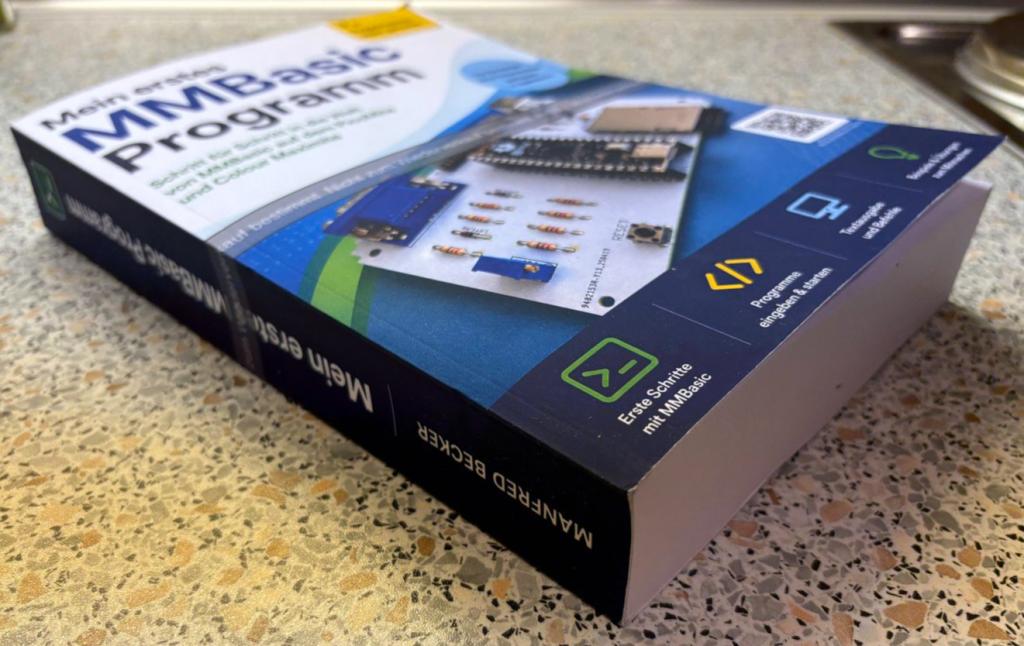
The first printed proof of My First MMBasic Program has arrived!
It is based on release 0.20 and has nearly 700 pages – and weighs an impressive 1.3 kg. So calling it a “paperback” is perhaps slightly optimistic.
Seeing all those chapters, BASIC programs and illustrations as a real printed book for the first time is quite a special moment for me.
Development hasn't stopped, though. Release 0.21 is already waiting in the wings and the KDP version is now approaching 800 pages.
And there is still one very special addition to come: Geoff Graham has kindly agreed to contribute a guest article to the book. I'm really looking forward to including that.
Before the final publication, I'll now use the proof copy to check the print quality, layout and readability – and probably find a few more little things to correct.
What started as a small German MMBasic tutorial has somehow turned into a 1.3 kg book. I certainly didn't expect that when I started!
If you'd like to see a few more photos and read more about the printed proof, I've posted a longer update on my blog: https://mikrocontroller.bplaced.net/ Edited 2026-09-30 07:40 by ManiB
lizby Guru Joined: 17/05/2016 Location: United StatesPosts: 3884
Posted: 10:46pm 29 Sep 2026
Copy link to clipboard
Print this post
Wow. I wish I'd had something like that for the micromite when I ordered my first 28-pin version just shy of 10 years ago. Of course, it would have been a much smaller book.

 Notice. New forum software under development. It's going to miss a few functions and look a bit ugly for a while, but I'm working on it full time now as the old forum was too unstable. Couple days, all good. If you notice any issues, please contact me.


 Print this post

 I think this is the book I would have bought and I will tell you why.
 (at least that one I looked at).