Notice. New forum software under development. It's going to miss a few functions and look a bit ugly for a while, but I'm working on it full time now as the old forum was too unstable. Couple days, all good. If you notice any issues, please contact me.
lizby Guru Joined: 17/05/2016 Location: United StatesPosts: 3885
Posted: 12:45am 18 May 2026
Copy link to clipboard
Print this post
I'm building a proof-of-concept H-bridge inverter on a PicoMite RP2350 and need complementary PWM outputs (A high when B low and vice versa) for the high-side and low-side gate drivers. Testing shows that PWM 1, 10000, 50, 50 drives both A and B in phase — not complementary. An overlap test confirmed 45,000+ simultaneous highs out of 100,000 samples, which would be shoot-through in a real H-bridge. My workaround is a 2N3904 inverter on the B output which works fine for the prototype. But I'm curious whether there's a native MMBasic way to get true complementary outputs — perhaps via POKE to the PWM hardware registers, or a CSUB, or something in the PWM command I'm missing?PicoMite, Armmite F4, SensorKits, MMBasic Hardware, Games, etc. on FOTS
phil99 Guru Joined: 11/02/2018 Location: AustraliaPosts: 3416
Posted: 01:06am 18 May 2026
Copy link to clipboard
Print this post
There was a couple of years ago. PLAY SOUND had a MONO option that gave complimentary L & R signals for a bridge amplifier. I experimented with this on a small inverter but the 44.1kHz PWM frequency was a bit high for the MOSFETs I was using so switching losses were significantly higher than at 10kHz.
Perhaps your PWM could be fed into pin 5 (CT) of a TL494 complimentary PWM driver. It can give a minimum deadtime. Edited 2026-05-18 11:29 by phil99
you can apply phase-correct mode in order to center both slices, use complementary and unequal duty amounts to produce precise deadband behaviour. Be aware that PWM period is halved when applying phase-correct mode.
Details can be found in RP2040 datasheet from P.546 on.
( You can always POKE into the registers, if any need:
ex. POKE WORD &H40050000,7 ' reconfig PWM slice 0 to run with phase correct mode, invert PWM0A and enable )
Best, Tom
matherp Guru Joined: 11/12/2012 Location: United KingdomPosts: 12051
Posted: 06:36am 18 May 2026
Copy link to clipboard
Print this post
This should all be doable with the inverted output and synch capabilities of the PicoMite. Synch is the key allowing two separate PWMs to be linked with an offset so that deadtime can be achieved as required
Volhout Guru Joined: 05/03/2018 Location: NetherlandsPosts: 6195
Posted: 06:42am 18 May 2026
Copy link to clipboard
Print this post
@lizby,
If you need exactly inverted outputs, from a single PWM, you can use negative PWM values. Note that the PWM value is a float, so you can get resolution that is built in the PWM hardware.
Pico peripherals work at 60-ish MHz (63 or 66). So when you run a 60kHz PWM you can get 10 bit resolution (2^10 = 1024). When you run 15kHz it will be 12 bit. The PWM's have 2 outputs A and B.
PWM n,freq,duty,-duty
will get you what you want. A has "duty" as dutycycle, B has "100%-duty" as dutycycle. The dead time has to be made in hardware.
But to drive an H bridge, you often need 2 PWM controlled pulses with 180 degrees phase difference. Then you can use 2 different PWM, that you phase lock. Then use output A from PWM1 and output A from PWM2 to drive the H bridge. You need to use PWM SYNC to start the 2 PWM's simultaneous. Now you can have A a duty cycle of 20%, and B also with duty cycle 20%, but they are 180 degrees appart. The dead time is now also easy to implement: have a maximum duty cycle of 49% (not 50%).
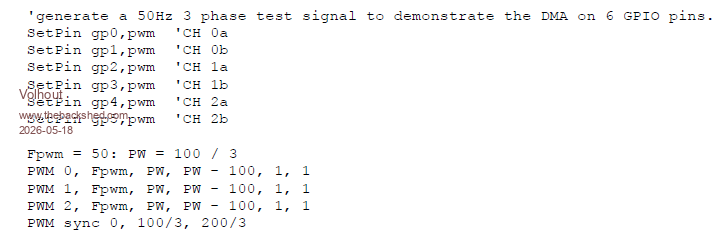
IF you look at example 3 in the user manual appendix F (this appendix is about PIO) it shows in a few lines (Phill's idea) how to create 6 H bridge signals for a 3 phase H bridge from 3 independent PWM's that are phase locked. Note, this is 50Hz, and they are 120 degrees appart.
In this example it is used to demo a simple logic analyzer running on PIO. But the test signal can be used to do what you need.

 Notice. New forum software under development. It's going to miss a few functions and look a bit ugly for a while, but I'm working on it full time now as the old forum was too unstable. Couple days, all good. If you notice any issues, please contact me.

 Print this post