
| Menu | JAQForum Ver 19.10.27 |
| Menu | JAQForum Ver 19.10.27 |
Forum Index : Microcontroller and PC projects : Been thinking about a SticoMite
  Page 2 of 2 Page 2 of 2 |
||||||
I think this might work. It's only tested in simulation and not thoroughly yet. :) Note, HDMI can source 5V but only up to 50mA. It's not good to depend on it. This one would need USB power as it's capable of working with a USB hub. There's a microSD on the back. The HDMI is protected roughly to spec with a diode and 100mA resettable fuse. The LED is on GP3 as GP25 was inaccessible. The HDMI plug is available from AliExpress and many other places. PCB must be 1.6mm for these. A load of pins are left off the PGA as they aren't needed - there's no room for GPIO ports! Sorry, no audio. I ran out of space. 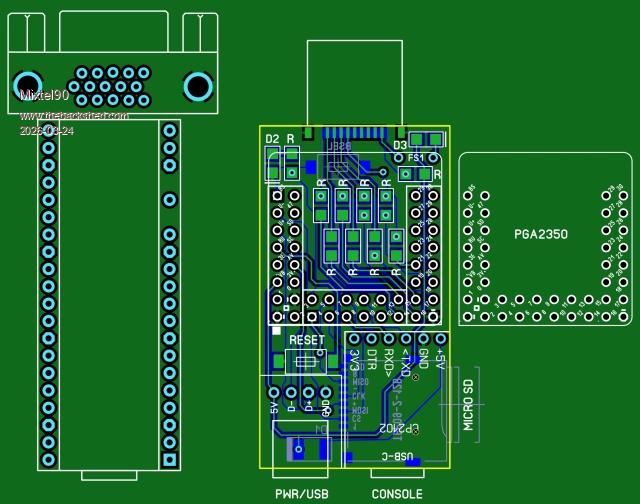 |
||||||
Hi Mick, Don't give up early. Under the CP2012 there is plenty of room for a MC4822 DAC in SO8 package. About GPIO pins. The rows you did not populate, can have a row of pins on the top side. So they would be accessible. The non-populated pins also have 2 grounds. So that would be usable. It would be nice (for case design) to also have the PWR/USB upside down, so CONSOLE and PWR USB-C's will be in one line. Easier for case design. Volhout Edited 2026-03-25 00:04 by Volhout |
||||||
Very short of space for a 3.5mm jack socket. I did try. :) My concept was to fit the PGA using only male pins, no sockets, to keep the height down and make it generally less bulky. I'm not sure if that would conflict with pins fitted from the top or whether it's even desirable to have them at all, after all this is behind a monitor. There is probably an I2C pair somewhere if GPIOs are needed. The CP2102 has the microSD socket on the other side. No space there unless the CP2102 is raised up. It's something to mess with on a rainy day... |
||||||
G'day, Needed to fire up the PCB engraver today for a couple of PCB's, so added this to the mix. Not exactly "off the shelf" but a proper board with a male plug shouldn't be that hard to have made by the usual suspects. I figure you either plug a USB cable PICO-HDMI monitor for power or PICO-PC for power and console so no need for anything else  depending on your application. depending on your application.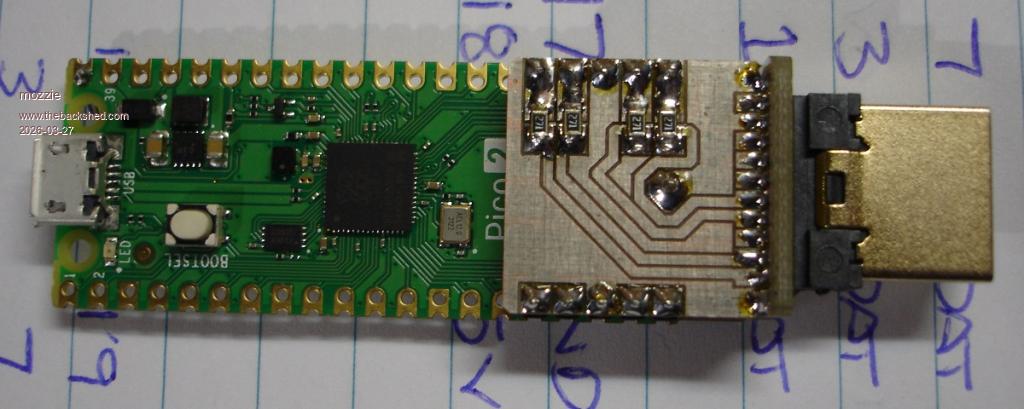 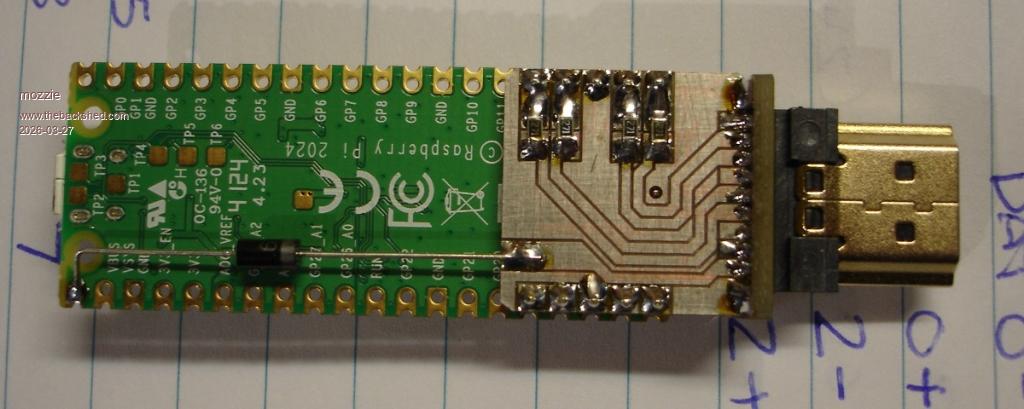 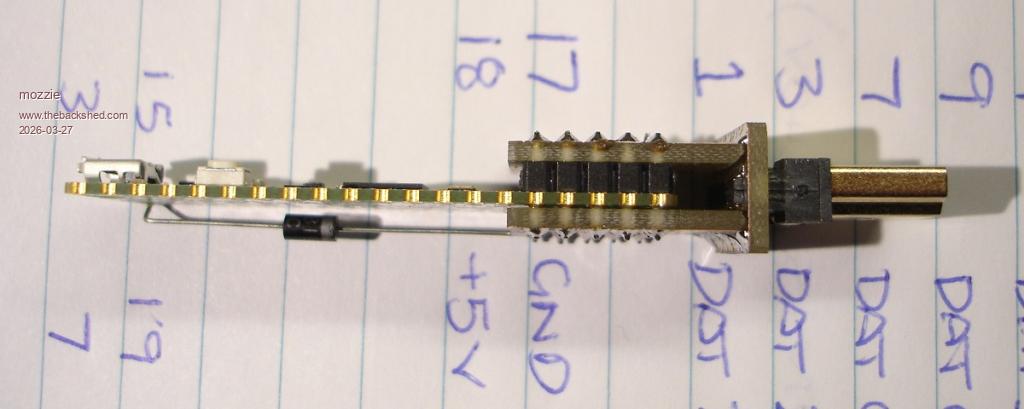 Works on everything its been plugged into so far, right up to 1280 resolution. Regards, Lyle. |
||||||
Nice work! From my point of (mechanic) view it would be better, to have two cable. I think the female version is more solid in the long run. To make your solution perfect it would be nice to have the console connection via a ESP-01 only and take the power from the TV/Monitor. Then a plug would make much sense.. Never the less, these are highres pictures and it is really well done, very good engraving job. Regards Dietmar |
||||||
You've only got a maximum of 50mA available from the 5V pin of a monitor's HDMI socket. That may be enough to run the Pico alone, if it's driving HDMI. An ESP module takes an average of 80mA with 430mA peak. You definitely need an external 5V supply. :) |
||||||
I thought of TV/Monitors which have USB and I thought that through the diode power is rather supplied.. |
||||||
G'day, A bit of reading through the HDMI spec has shown that only HDMI SOURCE devices supply 5V, HDMI SINK devices (monitors / TV's etc) do not. Sadly this means for this type of "PICO_STICK" device we need an external source of power. This being the case, the external USB-Serial device is either plugged into the monitor etc for power or into the PC for power / console. 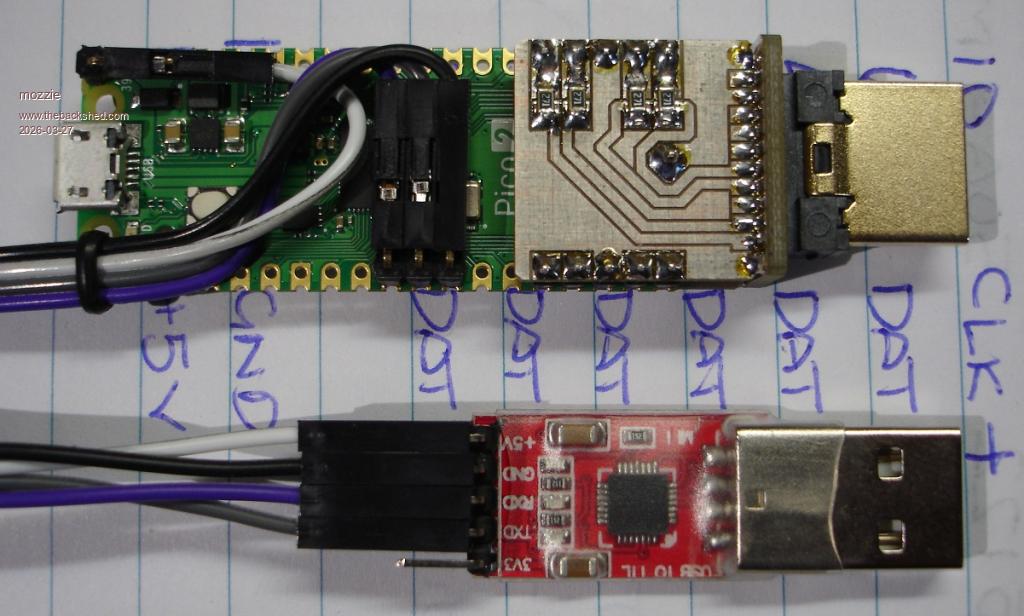 A wireless keyboard dongle plugged in and off you go 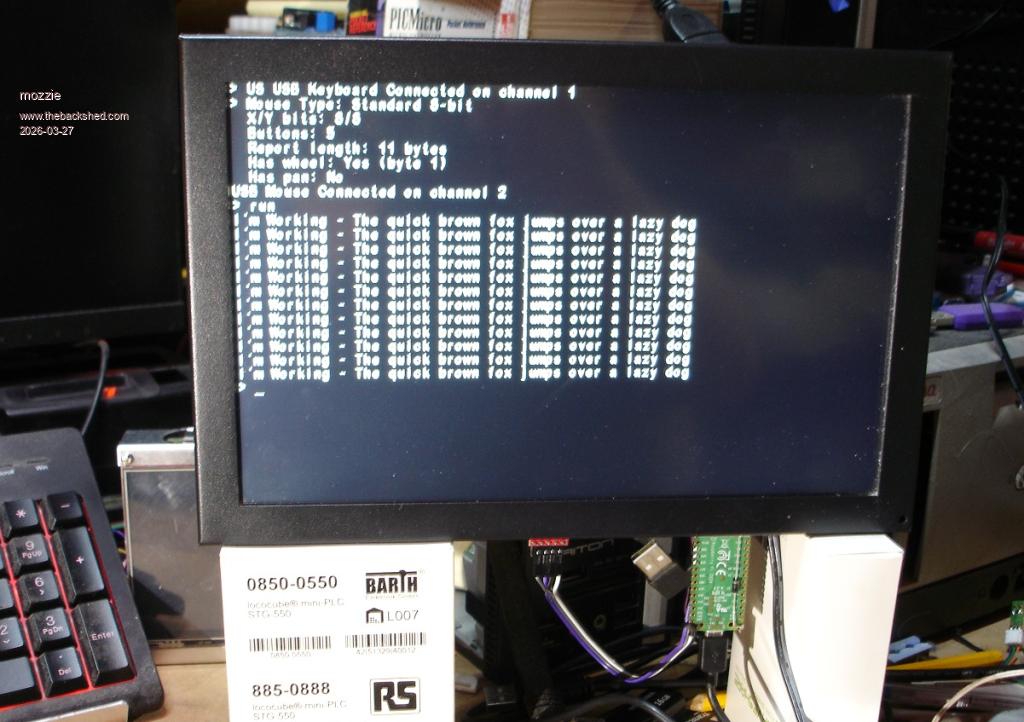 @DDDNS The HDMI sockets do appear to be more robust by design. The extension on the rear of the HDMI plug fits through a milled slot in the PCB and is soldered from the rear, pretty solid. 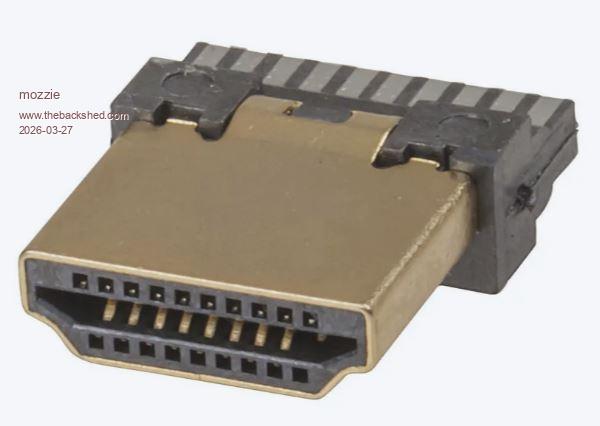 As usual, this is just a proof of concept but it seems like a great idea if someone makes a "proper" version. P.S. This still fits within the outline of the "over-mold" shown in the HDMI spec, this allows approx 21x11.5mm outline (unit is 11x20mm) Regards, Lyle. Edited 2026-03-27 14:52 by mozzie |
||||||
Hi Mozzie, Many monitors/TV's have a USB-A connector near the HMDI, specific for powering HDMI connected peripherals (or connecting a storage device). Volhout |
||||||
@Volhout You once posted that you have built a transparent serial to wifi bridge with ESP01 and ESP-Link or Tasmota. What is your experience in terms of response times and reliability? |
||||||
Hi dddns, tested I used ESP-NOW on ESP01. Round robin was 50ms. So I expect 25ms single path. Very consistent, as if detemined by some internal tick in the ESP8266. I wanted to use ESP-Now since it is independent of any WIFI and works on MAC addresses. I did not test ESP-link. Volhout |
||||||
I'll be honest, I'm not a great fan of this concept. I can see a use for it, where you want, for example, WiFi linked information displays, but otherwise I can't really see the point. You are putting connectors in an inaccessible place and limiting the connectors and facilities drastically.I'd rather have one wire to the back of the display - if it has a USB port then you can still use it as the power supply with a second wire, but that's an option. There are some displays with non-standard HDMI ports (MHL enabled) which can supply a lot more current than 50mA, but you can't count on anyone having them. They are the ones that use a special MHL lead to connect a mobile phone to the HDMI socket and can charge it. As I said though, it breaks some HTML compatibility. |
||||||
G'day Mick, Not sure what PhenixRising's original use case was but he mentions a stand-alone display. As you say, this type of thing is no good if you are looking to use I/O etc, and normally that is what I'm looking for as well. However, as shown in the pics above, with a unit like this plugged into HDMI and powered by the TV/Monitor via USB, and with a wireless keyboard plugged in, you have an instant on system to test code or just play around with MMBasic using the inbuilt editor. No mess, no fuss, no extra cables. Plug in 2 plugs and get coding. Worst case for a TV/monitor with no USB socket you need a USB phone charger, there must be a dozen hiding within 20 feet of me right now. In a previous job I was away 10 days out of 14 staying in various accommodation, these normally had a TV with HDMI, the original PICO_HDMI_STICK (PTH resistor version) was used for just this kind of thing, no need to drag out and fire up the laptop except for firmware upgrades and setup. The less crap to move in and out of a room the better, especially when you are living and working out of a ute. One of the great things about the whole PicoMite system is how flexible it is, and this is just another example. Shame I didn't build this new version ages ago as planned. Regards, Lyle. |
||||||
The Pico (plus) 2 W is also very attractive. I think it supports VGA222 and framebuffer, but I'm not sure..Together with a cheap VGA/HDMI converter it would then be a nice solution. On cost to carry a keyboard with me and having a not ergonomic view to screen, I'm not a fan of using the local console for development. To use your solution with a laptop/PC and a video grabber is another idea. For this a stick is much better. |
||||||
@Mick I've seen through-hole versions of the socket I think 1,27 pitch. Would love to mill it in the end ;) |
||||||
The socket I found on AE doesn't look too bad to solder even though it's surface mount. The pads are just a bit narrower than a microSD socket, but even numbers pins are on one side of the board and odd numbers on the other. The idea that I posted might work nicely if powered from a USB hub on the desk and running the HDMIUSB firmeware. That way you have mouse & keyboard. You still have console access via USB, of course. Oh, note that it's narrower than a VGA connector as well as shorter than a Pico + VGA. :) |
||||||
| Page 2 of 2 |
||||||
 |
The Back Shed's forum code is written, and hosted, in Australia. |


